Sales myths vs. facts
Sales advice is full of confident sentences that do not hold up when you check them. Some are harmless shorthand. Some lead people to buy the wrong program, skip a license they actually need, or describe a certificate as something it is not. This guide takes a few of the most common claims and sets them next to what official sources and the programs themselves actually say.
Nothing here is a job offer, a salary promise, or a claim that a credential will get you hired. SalesCredential is an independent, privately issued professional credential operated by Physician Consulting Group LLC. It is not a government license and it is not accredited by a university or a professional association. Where we describe our own exam and prices, we are describing this program only.
Myth: “You need a sales certification to work in sales.”
Fact: For most selling jobs in the United States, you do not. The U.S. Bureau of Labor Statistics (BLS), in its Occupational Outlook Handbook profile of wholesale and manufacturing sales representatives, notes that professional certification is not required, though some representatives choose to earn one. Educational requirements vary by the product: a high school diploma is generally enough to enter many nontechnical sales roles, while scientific or technical products often call for a bachelor’s degree.
That is the opposite of a license requirement. A certification can still be useful as evidence that you completed a defined course and, if there is an exam, that you met a published passing standard. It is not the same thing as permission from a state to do the work.
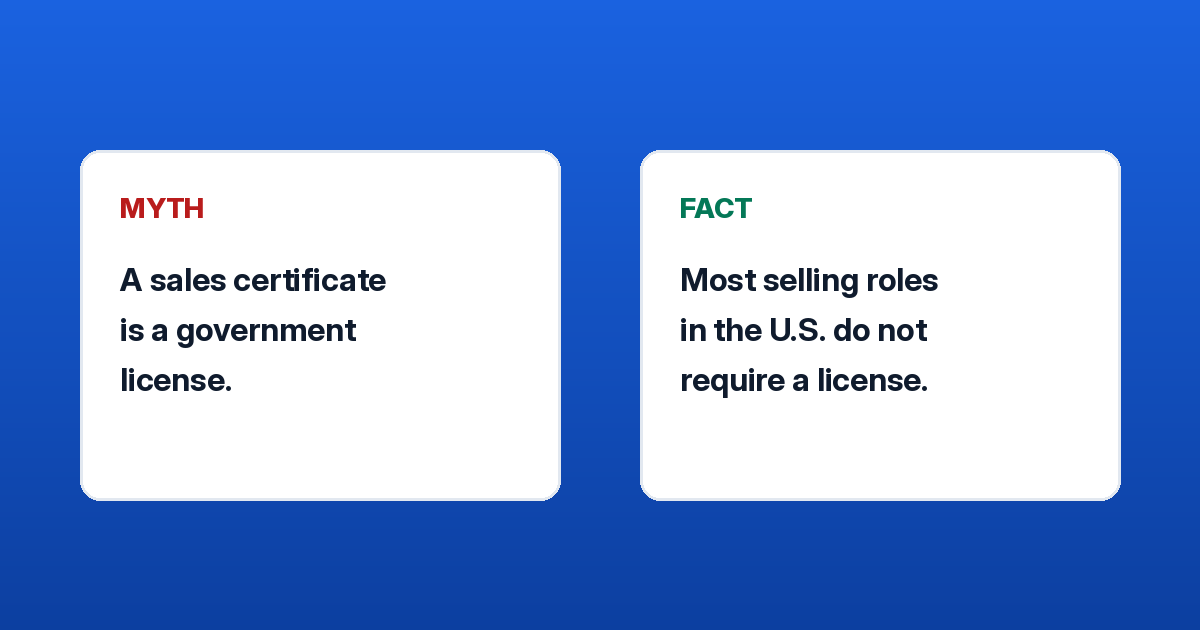
Myth: “A sales certificate is a license.”
Fact: A professional sales certificate is almost never a license. Some selling roles do require a license, but that requirement comes from the industry and the state, not from a private course. Insurance producers, real-estate brokers, and people who sell certain securities typically need a license or registration. A professional-selling certificate does not replace those.
If a provider’s marketing blurs “certified” and “licensed,” treat that as a warning. Our own terms say the SalesCredential Professional Selling Certification is not a government license, not an academic degree, and not an accreditation by a professional body. You should expect any serious program to say the same when it is true.
Myth: “A certificate guarantees a job or a raise.”
Fact: No honest program can guarantee that. BLS data describe employment, pay, and typical entry paths for sales occupations; they do not say that a certificate produces a hire or a salary step. When a website invents a placement rate or an average raise, ask for the primary source. If there is no source, do not repeat the number.
A credential can help you show that you learned a body of skills and passed a test. Hiring still depends on the employer, the role, your experience, and the interview. SalesCredential does not claim job placement or salary results, and we do not publish invented statistics.
Myth: “If I finished the videos, I am certified.”
Fact: That depends on the program, and the difference is worth getting right. Some courses issue a completion badge when you reach the end of the lessons. Others require a passing score on an exam, sometimes with a published standard and a way for a third party to check the result.
Those are not the same thing. A completion badge can still be a fair record of training. It should not be described as if you passed a professional exam. SalesCredential requires a 30-question exam and a 70 percent passing score; retakes are included. If you pass, the certificate has a unique ID that anyone can look up on our public Verify page. For a longer comparison, see our guide to certification versus a training course.
Myth: “The more I pay, the more employers will respect it.”
Fact: Price is information about the fee, not a measure of respect. Association programs, vendor academies, and independent credentials charge very different amounts. Some vendor certificates, including certain HubSpot Academy certificates, are free to take and have a published validity period — HubSpot’s knowledge base lists Inbound Sales as valid for two years. An expensive program can be thorough, or it can be a long video library with a handsome badge.
A better comparison is public and specific: What is in the syllabus? Is there an exam, and what is the passing score? Can someone else verify the result? How long is the credential valid, and what happens when it expires? Our regular price is $75; the next 50 buyers pay $49. The printed certificate, if you want one, is an optional $50 and ships only in the United States. All sales are final, which is why the syllabus is public.
Myth: “Once you are certified, it lasts forever.”
Fact: Many certificates expire. HubSpot’s Inbound Sales certificate, noted above, is listed as valid for two years. SalesCredential certificates are valid for two years from the issue date; after that they show as expired on the Verify page. A renewal option is planned but is not available yet. If you add a credential to LinkedIn or a résumé, you should keep the dates accurate and remove or update the entry when it lapses. LinkedIn’s own help article on licenses and certifications is the right place to check the current steps.
How to use this in a real decision
When you evaluate a program, write down four answers: whether a license is actually required for the job you want, whether the program uses an exam with a published standard, whether a third party can verify the result, and what the credential costs and how long it lasts. If a sales page cannot answer those questions, email the provider before you pay.
Myths spread because they are short. The facts are only slightly longer, and they will save you from buying the wrong thing — or from describing the right thing as something it is not.
Want a credential people can check?
SalesCredential is an 8-module professional selling course with a 30-question exam, a unique credential ID, and 2 years of public verification. The regular price is $75; the next 50 buyers pay $49. All sales are final, so read the syllabus first.
Sources
- U.S. Bureau of Labor Statistics, Wholesale and Manufacturing Sales Representatives, Occupational Outlook Handbook (education, training, and the note that professional certification is not required). Retrieved November 16, 2026.
- HubSpot Knowledge Base, Validity period of HubSpot certifications (Inbound Sales is listed as valid for two years). Retrieved November 16, 2026.
- LinkedIn Help, Manage Licenses & certifications. Retrieved November 16, 2026.
- SalesCredential Terms of Service (independent, privately issued credential; not a government license; prices; two-year validity; all sales final).